French Knitwear Brands: Wool, Merino and Natural-Fibre Knits
The first thing I do with a sweater in a Paris boutique is turn it inside out and read the label. French knitwear brands can offer beautiful wool cardigans, fine merino layers and cotton knits, but the name on the front tells me less than the composition inside.
This is my guide to choosing French sweaters and cardigans with natural fibres first: wool, merino, cotton, yak and selected blends. For pure-cashmere sweaters and specialist houses such as Bompard and Kujten, see my separate guide to French cashmere brands. Here, the focus is the rest of the knitwear wardrobe.
This article contains affiliate links. If you buy through one, I may earn a commission at no additional cost to you. Merci for your support.

French knitwear brands at a glance
These are starting points for specific kinds of knitwear, rather than a fibre rating for an entire brand. Compositions refer to the named style and colour checked in November 2026; another version may differ. If you’re looking for French-made knitwear, see the manufacturing notes for Molli and Saint James.
| Brand | Best place to start | Fabric note | Shop |
|---|---|---|---|
| Sézane | Cotton layers and cardigans | Léontine has a cotton body; check trims | Léontine cotton jumper |
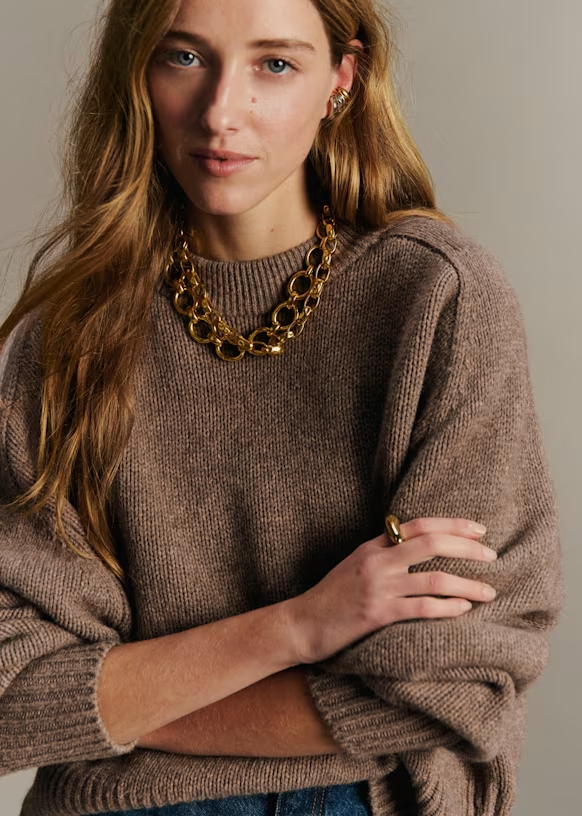
| Balzac Paris | A brown knit with statement cuffs | Solène: ribbed collar and ruffled cuffs | Solène sweater in brown |
| Molli | Textured and finely finished wool knits | Trésor: 100% virgin wool | Trésor wool sweater |
| Rouje | Fitted wool knits and detailed necklines | Clarissa: 100% wool | Clarissa wool sweater |
| Soeur | A substantial cardigan | Leonard in caramel: 100% merino | Leonard merino cardigan |
| Gérard Darel | Fine merino layers and cardigans | René: 100% merino | René merino cardigan |
| Vanessa Bruno | Relaxed shapes and colour | Hinde in matcha: 50% merino, 50% yak | Hinde merino and yak sweater |
| Saint James | Traditional sailor sweaters | Matelot: pure new wool | Cancale Chiné sailor sweater |
| Lemaire | Shape, proportion and fine wool | Selected 100% wool styles | Ecorce wool cardigan |
| Loulou de Saison | Roomy cuts and soft wool blends | Check each style; some contain nylon | Tristan wool and yak sweater |
| Barnie | A smaller-label alternative | Cléa: cotton, wool and alpaca | Cléa textured sweater |
| Isabel Marant / Marant Étoile | Selected cotton and cotton-wool knits | Azelia: 100% cotton; avoid synthetic-heavy styles | Azelia cotton sweater |
| Sandro | Selected wool polos and sweaters | Pointelle polo: 100% wool; check other trims | Pointelle wool polo |
| Maje | Patterned wool knits | Wool bodies; small synthetic additions in ribbing | Fair Isle wool sweater |
| A.P.C. | Simple merino layers | Check the fitted merino styles | Anna wool sweater |
Where I’d start. For a lighter striped knit, start with Sézane’s cotton Léontine. For a brown sweater with more detail, try Balzac Paris’s Solène. For a cardigan with enough shape to wear on its own, look at Soeur’s Leonard.
French knitwear brands for wool, merino and natural blends
I would begin with the garment I am missing: a fine layer for a jacket, a cardigan to wear as a top, or a heavier sweater for cold days. That makes the differences between these brands much more useful than a single ranking.
Sézane
I would choose Sézane by style rather than make Gaspard stand for the whole brand. Léontine in ecru/navy has a main fabric of 100% organic cotton, but the page separately lists a polyester strip. Gaspard in ecru has 37% mohair, 37% alpaca and 26% polyamide in its main fabric, plus a polyester strip. For this edit, Léontine is the closer fit; Gaspard is a deliberate exception rather than a natural-yarn recommendation. Compare Léontine’s main fabric and trim. Shop Léontine in ecru and navy.
Balzac Paris

Balzac Paris is where I look for a knit with a detail that can carry an outfit. The brown Solène has a ribbed collar, a seam down the front and ruffled cuffs that peek out under a coat. I’d wear it with blue jeans and loafers and let the cuffs do the work. Shop the Solène in brown.
Molli

Molli is where I would look for the knitting itself: textured stitches, shaped edges and details that give a plain wool top character. The Trésor sweater in bleu minéral is listed as 100% extra-soft virgin wool and knitted and assembled in France. Other styles differ: the Drum in nuit lists 98% virgin wool, 1% polyamide and 1% elastane. See the Trésor composition. Shop the Trésor sweater.
Rouje

Rouje is worth browsing for fitted shapes, distinctive necklines and buttons. The Clarissa in beige is listed as 100% wool and made in Italy, with a ribbed high neck, raglan sleeves and small openings at the neckline. I would start there for a wool sweater with a little more detail. The wider collection includes blends too: Simeon in ecru lists 80% wool and 20% polyamide, so I would not use that cardigan as a natural-fibre example. See the Clarissa wool sweater.
Soeur

Soeur’s roomy cardigans work well when I want a knit to act as a light outer layer. The Leonard in caramel is listed as 100% merino wool, with a rounded shape, dropped shoulders and a stand collar. It is made in Mauritius, a useful reminder that French design and French manufacture are separate things. See the Leonard in caramel. Shop the caramel Leonard.
Gérard Darel

Gérard Darel is a useful starting point for fine merino layers with simple necklines and easy proportions. The René cardigan in brown is listed as 100% merino wool, with a round neck and a straight shape. I would try it buttoned as a top or open over a shirt. The Reine short-sleeve sweater also has a 100% merino composition, making the brand worth a closer look for everyday wool pieces. See the René merino cardigan.
Vanessa Bruno

Vanessa Bruno is worth keeping on a natural-fibre shortlist. The Hinde in matcha is listed as 50% merino wool and 50% yak, with a relaxed crew neck and dropped shoulders. I would wear its soft green with brown trousers or ecru denim. Other knits use different blends; this recommendation belongs to Hinde, not every sweater carrying the label. See Hinde’s yarn composition. Shop Hinde in matcha.
Saint James: the pull marin

Saint James is where I would start for a traditional sailor sweater. Its Matelot is listed as pure new wool and made in the brand’s Normandy workshops, with the compact knit and shoulder fastening associated with the style. A pull marin is a knitted sailor sweater; a marinière usually means the striped cotton jersey top. Read about the wool used in Matelot.
Lemaire


Lemaire earns its place for cut and proportion. The short-sleeve fine-merino sweater, style PO0045 LK1070, is listed as 100% wool and made in Portugal. I would compare its shape with a less expensive wool knit before deciding whether the design justifies the price. Other Lemaire yarns contain blends, so the label still matters. More on the design in my Lemaire guide. See the fine-merino sweater.
Loulou de Saison

Loulou de Saison’s appeal is its easy volume: relaxed shoulders and shapes that sit comfortably over trousers or a skirt. Its wool-rich blends offer an alternative to pure cashmere when I want an easy everyday layer. The Azali illustrates why checking matters: it lists 50% wool, 40% yak and 10% polyamide. That is a blend to weigh individually, rather than call fully natural. See the Azali blend.
Barnie

Barnie offers an alternative to the larger Paris labels. Its Cléa sweater in beige chiné is listed as 50% cotton, 35% wool and 15% alpaca, with raglan sleeves and stitch detail around the neck. The cotton gives this a different role from a dense winter sailor knit. The product page states that it is made in China. See the Cléa sweater.
Isabel Marant and Marant Étoile

Isabel Marant and Marant Étoile need a selective approach. There are natural-fibre options: the Azelia in ecru is listed as 100% cotton, while the Kalyn in light yellow combines 70% cotton and 30% wool. These openwork styles are useful starting points for lighter knits, rather than substitutes for a dense winter sweater. See the cotton Azelia.
The heavier knits deserve particular scrutiny. Lily in beige contains 17% acrylic and 13% polyamide alongside alpaca, mohair and wool: 30% synthetics in total. I would leave it out of this natural-fibre selection and keep the recommendation to named styles whose yarns fit the brief. Compare Lily’s full composition.
Sandro

Sandro has enough wool options to merit a selective place in this guide. The grey pointelle polo-neck sweater lists 100% wool, while the blue short-sleeve sweater and navy V-neck both have 100% wool main fabrics. These offer different necklines and sleeve lengths, rather than just several colours of one knit. See the pointelle wool polo.
The trim needs a separate check. On the blue short-sleeve style, the ribbing is 98% wool, 1% polyamide and 1% elastane; on the navy V-neck, it is 94% wool, 4% polyamide and 2% elastane. Those are small additions within the ribbing, not percentages of the whole sweater. For this edit I would begin with the pointelle style and consider the others individually.
Maje

Maje offers wool knits with more decoration: Fair Isle patterns, argyle and jewellery-like buttons. The navy jacquard sweater has a 100% wool main fabric, but its ribbing is 94% wool, 5% polyamide and 1% elastane. The navy-and-green argyle sweater similarly has a pure-wool body with a small synthetic addition in the ribbing. I would consider these as wool-led options with functional trim, rather than describe the complete garments as 100% natural. See the jacquard sweater’s full label.
A.P.C.

A.P.C. is a useful starting point for restrained crews, fitted merino sweaters and cardigans. I would look here when the knit needs to sit neatly under a jacket rather than dominate an outfit. The fitted merino sweater checked here lists 100% wool; its wider women’s range also includes blended yarns, so I would not give the whole collection a natural-fibre guarantee. Start with the fitted merino sweater.
How to read the fabric label
Wool and merino are sheep fibres; merino names a type of wool, not a separate synthetic material. Cotton and silk are natural fibres too. Polyamide and nylon are two names for the same family of synthetic fibre. Viscose and lyocell are regenerated cellulose fibres, so I would describe them separately from both wool and petroleum-based synthetics.
My preference is for 100% natural yarns, with room for a small functional blend when the finished piece earns it. There is no universal percentage at which a sweater becomes poor quality, and the label alone cannot reveal why the designer chose a particular yarn. A fine fluffy knit and a dense sailor sweater have different jobs.
Read the full breakdown, including trims. A product described as a wool sweater may also contain nylon or acrylic; a cotton body may have a polyester reinforcement. Then try it against the skin, check the cuffs and seams, and consider whether it fits under the coat you actually wear.
Is more expensive knitwear worth it?
A higher price can buy a distinctive cut or more elaborate knitting, but it does not guarantee a natural composition or a longer life. I would pay extra for a shape I cannot find elsewhere, a finish I can see, or a fabric that feels right on me. A brand name is not a substitute for those checks.
Pilling also needs more nuance than a natural-versus-synthetic verdict. Fibre length, yarn construction, knitting and friction all affect the result. Pure wool can pill, and a blend can be durable. Fibre percentages alone cannot predict how many years a sweater will last.
Before buying, I would check whether the fabric is already heavily fuzzy at rubbing points, whether the seams lie comfortably, and whether the ribbing feels resilient. I would also read the care label: a piece that needs specialist cleaning has a different ongoing cost from one I can safely wash at home.
Choosing knits for an everyday wardrobe
For a small wardrobe, I would begin with a fine layer and a more substantial cardigan or crew neck. A cotton knit offers another option for milder days. The useful distinction is how each piece fits and layers, rather than collecting several sweaters that all do the same job.
Try a cardigan buttoned as a top, then open over a shirt. Put on the jacket before deciding on the sleeve volume. For outfit examples, see my November outfits in Paris.
Follow the individual care instructions and store knits folded. Airing can help between wears, but it does not replace washing a dirty garment. Comfort and care depend on the finished garment and the wearer, so try the knit against your skin rather than relying on a softness claim.
FAQ: choosing French knitwear
Start with specific pieces: Gérard Darel’s René and Soeur’s Leonard in merino, Molli’s Trésor in virgin wool and Vanessa Bruno’s Hinde in merino and yak. Sandro, Rouje, Maje and Isabel Marant also have selected options, but check the full composition and any separate trim listing.
Not necessarily. A French brand may design in France and manufacture elsewhere. Saint James’s Matelot and Molli’s Trésor are examples with French production stated by the brands; other pieces in this guide are made in countries including Italy, Portugal, Mauritius and China.
Yes. A wool blend can contain polyamide, polyester, acrylic or elastane alongside wool. Read the percentages and any separate trim listing; the phrase wool sweater does not mean 100% wool.
It depends on your priorities and the finished piece. A small amount can be worth considering for a particular yarn or construction. It is still synthetic, and no single percentage guarantees either good or poor quality.
Choose by garment. Léontine in ecru/navy lists a 100% organic-cotton main fabric with a separate polyester strip, while Gaspard in ecru has 26% polyamide in its main fabric. They should not be described as equivalent compositions.
This guide focuses on wool, merino, cotton, yak and selected blends across French ready-to-wear and knitwear labels. The separate cashmere guide focuses on pure-cashmere sweaters and cashmere specialists. A label can appear in both when the recommended garments serve different needs.
Start with the sweater you will wear
I would try one useful knit with the trousers, shoes and coat I already reach for. If the neckline feels wrong or the sleeves bunch under a jacket, a beautiful label will not fix it. For building around the pieces that work, my French capsule wardrobe guide takes that approach further.
For your next Paris trip
Shop Saint-Germain Like a Local
30+ hand-picked boutiques, an interactive map, and 10 years of Left Bank insider knowledge — so you can skip the tourist traps and spend your time actually discovering. $17, instant download.
Get the Guide


